Re-Entry: How to Rebuild Your Healthcare Network Without Starting From Zero


Whether you’ve been buried in a grueling clinical rotation, managing a massive EHR implementation, or working double shifts in patient care, it’s easy to let your professional network go quiet.
In this field, making connections is important, particularly when thinking of moving within your career! Whether it’s moving into administration, pivoting to health tech, or finding a better-balanced clinical role, that path is built from where you are NOW.
The good news is that you don't need to attend five mixers a week to fix this.🎉 You just need a re-entry strategy.📝
Here’s how you can get started:
Step 1: Auditing Your "Dormant" Network
Most people think they have no network because they haven't "networked" recently. In reality, you have a wealth of dormant ties. These are former colleagues, supervisors, or classmates you haven't spoken to in 6+ months.
Research shows that dormant ties are actually more valuable for job seekers than close friends because they offer access to information and circles you aren't already part of.
The "High-Value" Audit:
Tier | Contact Type | Why They Matter |
|---|---|---|
The Advocate | Former Managers / Mentors | They can speak to your clinical or technical growth. |
The Pivot | Friends in different sectors (e.g., Tech, Pharma) | They provide the "insider" view of a different niche. |
The Peer | Former classmates or co-workers | They are often at the same career stage and share leads. |
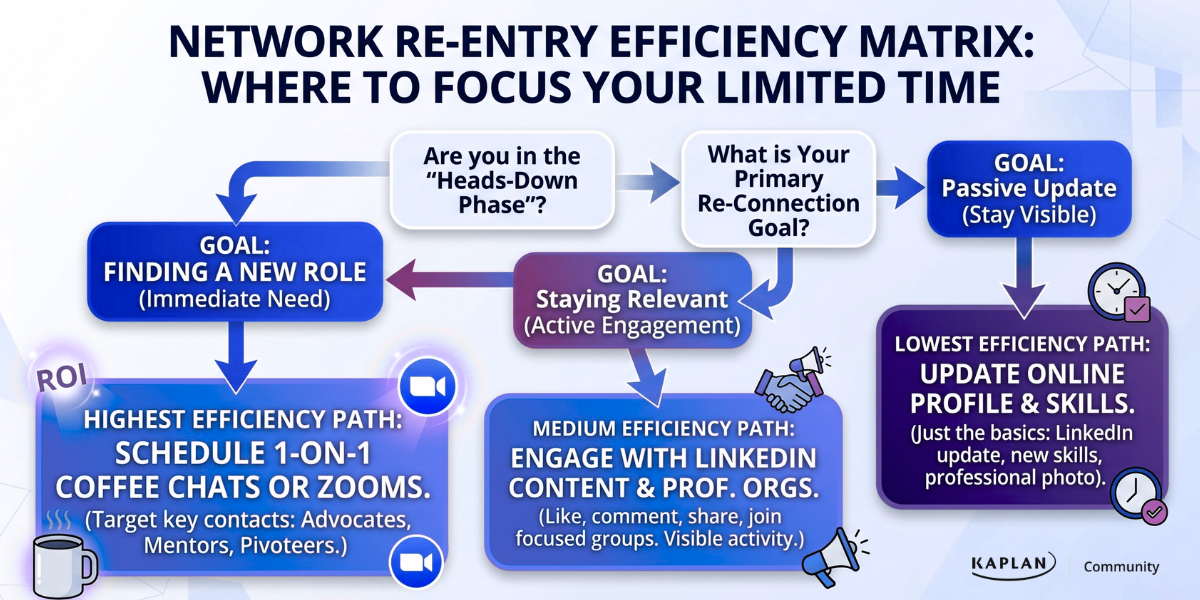
Step 2: The Efficiency Matrix
You’re busy.
You don't have time for fluff.
Use this matrix to decide where to put your limited energy for the biggest ROI (Return on Interaction).⬇️
Step 3: The "Low-Friction" Reach Out
When you've been "heads-down," the biggest hurdle is the guilt of not reaching out sooner. Don't over-explain. Acknowledge the silence and move on.
The Script: "Hi [Name], it’s been a while! I’ve been deep in the trenches of [Patient Care/Project Name] lately, but things are finally coming up for air. I saw your recent post about [Topic] and loved your take. Would love to catch up for 15 minutes soon!"
Why Your Network is Your "Clinical Safety Net"
Having a broad network across different roles (IT, Admin, Medical) allows you to:
- Identify Burnout Patterns: See how other facilities are handling staffing before you apply.
- Skill-Cross-Pollinate: Learn about new billing codes or tech tools from colleagues in different departments.
- Peer Support: Only another healthcare professional understands the specific weight of the "heads-down" season.
The Bottom Line
You aren't starting from zero. You are starting from experience.✨
Your network didn't disappear while you were focused on your patients or your projects; it just went to sleep. It’s time to wake it up.⏰
Let’s help each other out: If you could give one piece of advice to a colleague who feels "stuck" in their current role and disconnected from the industry, what would it be? Share your best tip for a quick professional "re-connect" below!