🎥 Never Stumble Over "Tell Me about Yourself" Again - Build Your Clear Career Story

Superstar
🤩
In a crowded job market, your career story is one of the most powerful tools you have. It’s the narrative that connects your experiences, skills, and goals into a clear, memorable picture of who you are professionally.
When your story is scattered or vague, interviewers struggle to understand how you fit. When it’s clear and intentional, everything else in the interview becomes easier.
This mini‑guide will help you define and communicate a strong career story…whether you’re an early‑career professional, a more experienced professional, or a career pivoter.
What Is a Career Story (And Why It Matters)?
Your career story is a concise narrative that answers three questions:
- Who are you as a professional right now?
- How did you get here…what experiences shaped your skills?
- Where are you going next, and why does this role make sense for you?
Interviewers rarely use the phrase “career story,” but they constantly look for it. When they ask “Tell me about yourself,” “Walk me through your resume,” or “Why are you interested in this role?” they’re testing whether your path makes sense and whether you can explain it clearly.
A strong story helps you:
- Make even a non‑linear path feel intentional.
- Highlight the most relevant parts of your background quickly.
- Stand out as someone who is focused and self‑aware.
A Simple Structure You Can Use
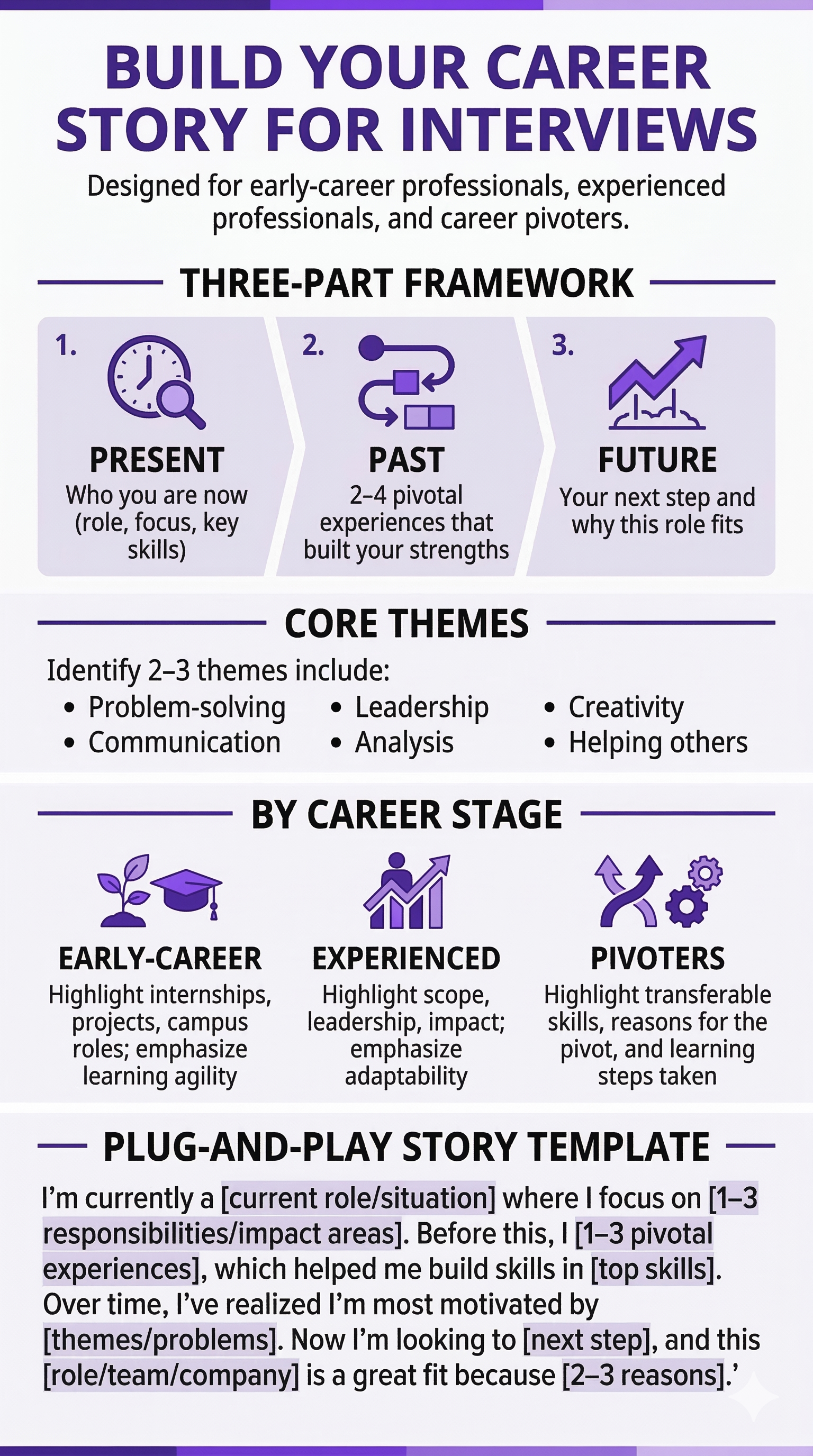
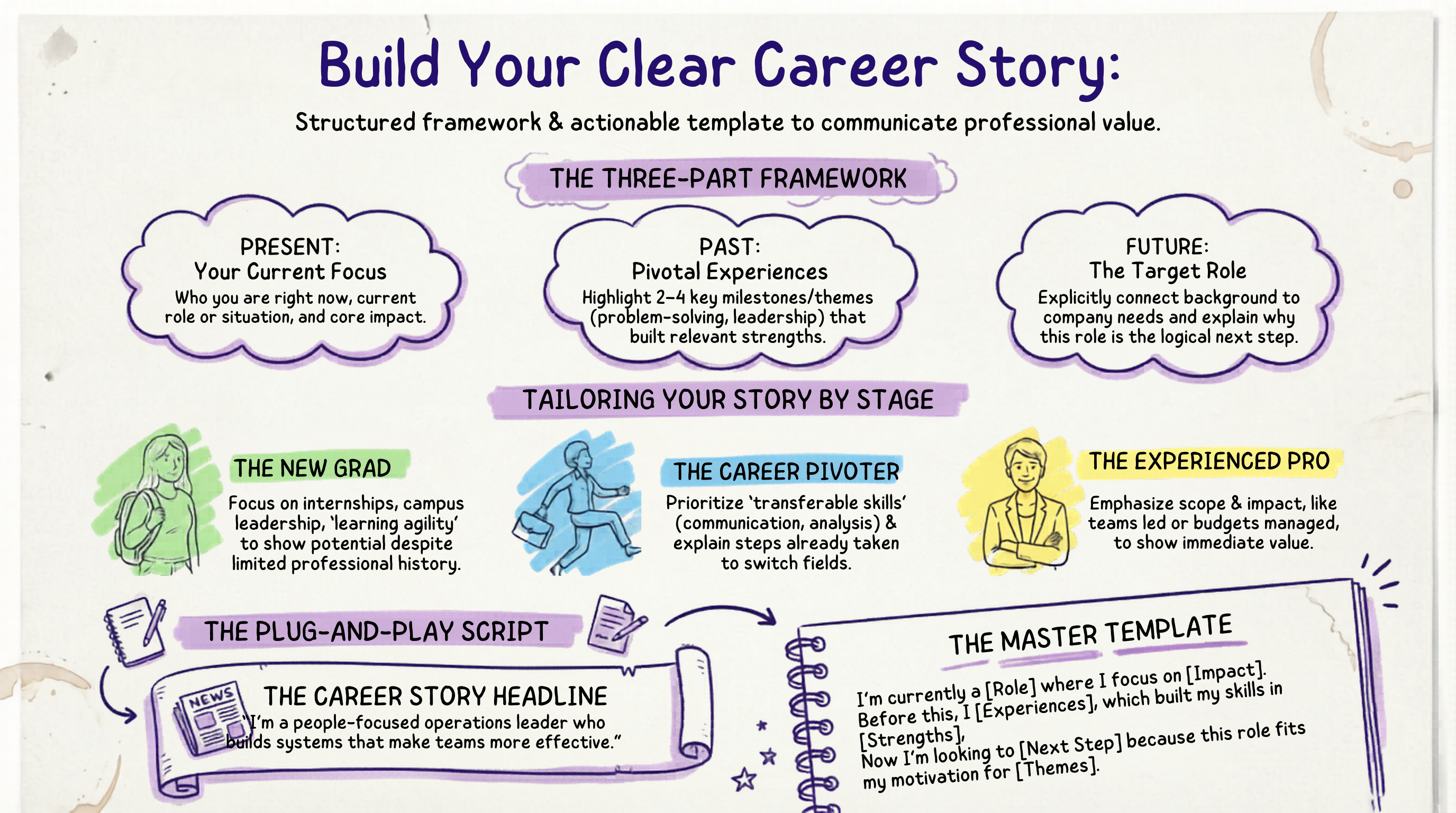
You can build your story around a three‑part structure:
- Present – Who you are and what you do now.
- Past – The key experiences that built your skills.
- Future – What you want next and why this role fits.
Example skeleton you can adapt:
- Present: “I’m currently a [role or situation] at [organization/school] where I focus on [core responsibilities or impact].”
- Past: “Before that, I [briefly describe 1–3 key experiences] that helped me build strengths in [top skills relevant to this role].”
- Future: “Now I’m looking to [your next step], and this [role/team/company] is a strong fit because [specific reasons].”
This structure works for “Tell me about yourself,” “Walk me through your background,” and even networking conversations.
Step‑by‑Step: How to Build Your Story
Step 1: Identify Your Core Themes
Look across your roles, internships, projects, and experiences. What keeps showing up?
Common themes include:
- Problem‑solving
- Communication and relationship‑building
- Analysis and data
- Leadership and ownership
- Building and improving processes
- Creativity and innovation
- Helping and supporting others
Pick 2–3 themes that genuinely describe how you like to work and what you’re good at. These become anchors in your story.
Step 2: Choose Your “Headline”
If someone had to remember one sentence about you after the interview, what would it be?
Examples:
- “I’m an early‑career marketing professional who enjoys using content and data to grow audiences.”
- “I’m a people‑focused operations leader who builds systems that make teams more effective.”
- “I’m a former teacher pivoting into learning and development, bringing deep experience in designing engaging learning experiences.”
You don’t need to say this headline word‑for‑word in every interview, but it should guide the rest of your story.
Step 3: Select 2–4 Pivotal Experiences
You don’t need to recap your entire resume. Instead, choose a few key moments that:
- Show your themes in action.
- Build directly toward the kind of role you’re pursuing now.
For each pivotal experience, ask:
- What did I do?
- What did I learn?
- How does this connect to what I want to do next?
Use those answers to create short, focused lines that you can plug into your story.
Step 4: Connect to Your Target Role
This is where many candidates fall short. They describe their past but never clearly link it to what they’re applying for.
Make the link explicit:
- What does this role actually need (skills, behaviors, outcomes)?
- Which parts of your story best prove you can do that?
- How can you say that in one or two clear sentences?
For example:
- “Because I’ve spent the last two years managing cross‑functional projects and improving internal processes, I’m excited about this role’s focus on coordinating complex initiatives and driving operational efficiency.”
Tailoring Your Story by Career Stage
For Early‑Career Professionals
If you’re in your first few years of work or about to enter the workforce, you may feel like you “don’t have a story yet.” You do.
Emphasize:
- Internships, part‑time jobs, campus roles, volunteer work, and significant academic projects.
- Times you took initiative, led something, or saw a project through from idea to result.
- Your learning agility, curiosity, and ability to pick up new tools or responsibilities quickly.
Example angle:
- “I’m an early‑career professional with internships in [field] and campus leadership experience where I [impact]. Together, those experiences have helped me build skills in [top skills], which is why I’m excited to start my career in [role/industry].”
For Experienced Professionals
Your challenge is not lack of content…it’s focus.
Emphasize:
- Scope and impact (teams led, budgets managed, complexity handled).
- Patterns in your work (for example, “I build teams,” “I fix broken processes,” “I scale new initiatives”).
- How your accumulated experience positions you to add value quickly in this new role.
Example angle:
- “Across my last three roles, I’ve consistently been the person who steps into complex situations, clarifies priorities, and aligns teams around execution. That’s exactly why this [role] focused on leading cross‑functional initiatives stood out to me.”
For Career Pivoters
Your priority is connecting dots.
Emphasize:
- Why you’re pivoting…what you discovered about your interests or strengths.
- Transferable skills from your previous field (communication, analysis, leadership, problem‑solving, stakeholder management).
- Concrete steps you’ve already taken to move into the new area (courses, certifications, self‑study, projects, informational interviews).
Example angle:
- “I started my career in [old field], where I developed strong skills in [transferable skills]. Over time, I realized I was most energized by [aspect that connects to new field], which led me to [courses/projects]. Now I’m excited to bring that foundation into [new field/role].”
Common Mistakes to Avoid
When crafting your career story, watch out for:
- Overloading with detail: You don’t need every role and date; you need the highlights that support your direction.
- Apologizing for your path: Non‑linear careers are common; own your choices and focus on what you learned.
- Sounding generic: “I’m passionate” without specifics doesn’t land. Use concrete examples instead.
- Skipping the future: Don’t forget to clearly state what you want next and why this role fits.
How to Practice Your Career Story
A strong story is built once but refined often.
Try this:
- Write your story out in a few short paragraphs using the Present → Past → Future structure.
- Read it out loud and trim anything that feels repetitive or overly formal.
- Practice sharing it in 60–90 seconds, without memorizing it word‑for‑word.
- Ask a friend or mentor, “If you had to describe my story in one sentence, what would you say?”
- Adjust until the answer they give matches how you want to be perceived.
Your story should feel natural, flexible, and true to you…not like a script you’re reciting.
A Simple Template You Can Fill In
You can use this template as a starting point and customize it:
“I’m currently a [your current role or situation] where I focus on [1–3 key responsibilities or impact areas]. Before this, I [brief summary of 1–3 pivotal experiences], which helped me build strong skills in [top 3–4 relevant skills]. Over time, I’ve realized I’m most motivated by [the themes or types of problems you like to work on]. Now I’m looking to [your next step], and this [role/team/company] is a great fit because [2–3 specific reasons].”
This gives early‑career professionals, experienced professionals, and career pivoters a flexible foundation they can revisit as they grow.
Click on the image below to print or save our tips formula for building your career story ⬇️