🎥 Why Your LinkedIn Personal Brand Is Your Most Valuable Career Asset in 2026

Superstar
🤩Your LinkedIn profile is doing one of two things right now. It's either working for you, quietly building credibility and attracting the right opportunities, or it's sitting idle while someone equally qualified gets the call you deserved.
The difference almost always comes down to personal brand.
In 2026, personal branding on LinkedIn isn't a nice-to-have for executives or content creators. It's a practical career tool for anyone who wants to be found, taken seriously, and remembered. Whether you're a student landing your first role, a professional pivoting industries, or a seasoned expert looking to stay visible in a competitive market, the way you show up on LinkedIn shapes how people perceive your value before they ever meet you.
Here's why it matters, and exactly how to build it.
Why Personal Branding on LinkedIn Matters More Than Ever
LinkedIn has shifted from a digital résumé repository into a professional search and discovery engine. Recruiters, hiring managers, and potential collaborators are using it to find people based on expertise, not just job titles. The platform's AI-powered search now evaluates meaning and relevance, which means your profile needs to clearly signal who you are, what you know, and who you serve.
The numbers back this up. Recent research from Edelman and LinkedIn found that decision-makers frequently trust thought leadership content more than traditional marketing materials. That same research found that very few professionals are producing content that people actually rate as excellent. The gap between average and outstanding is wide open, and that is your opportunity.
Beyond discoverability, personal branding builds the kind of trust that advances careers. People hire, refer, and collaborate with professionals they recognize and respect. A strong LinkedIn presence puts you in that category before a single conversation happens.
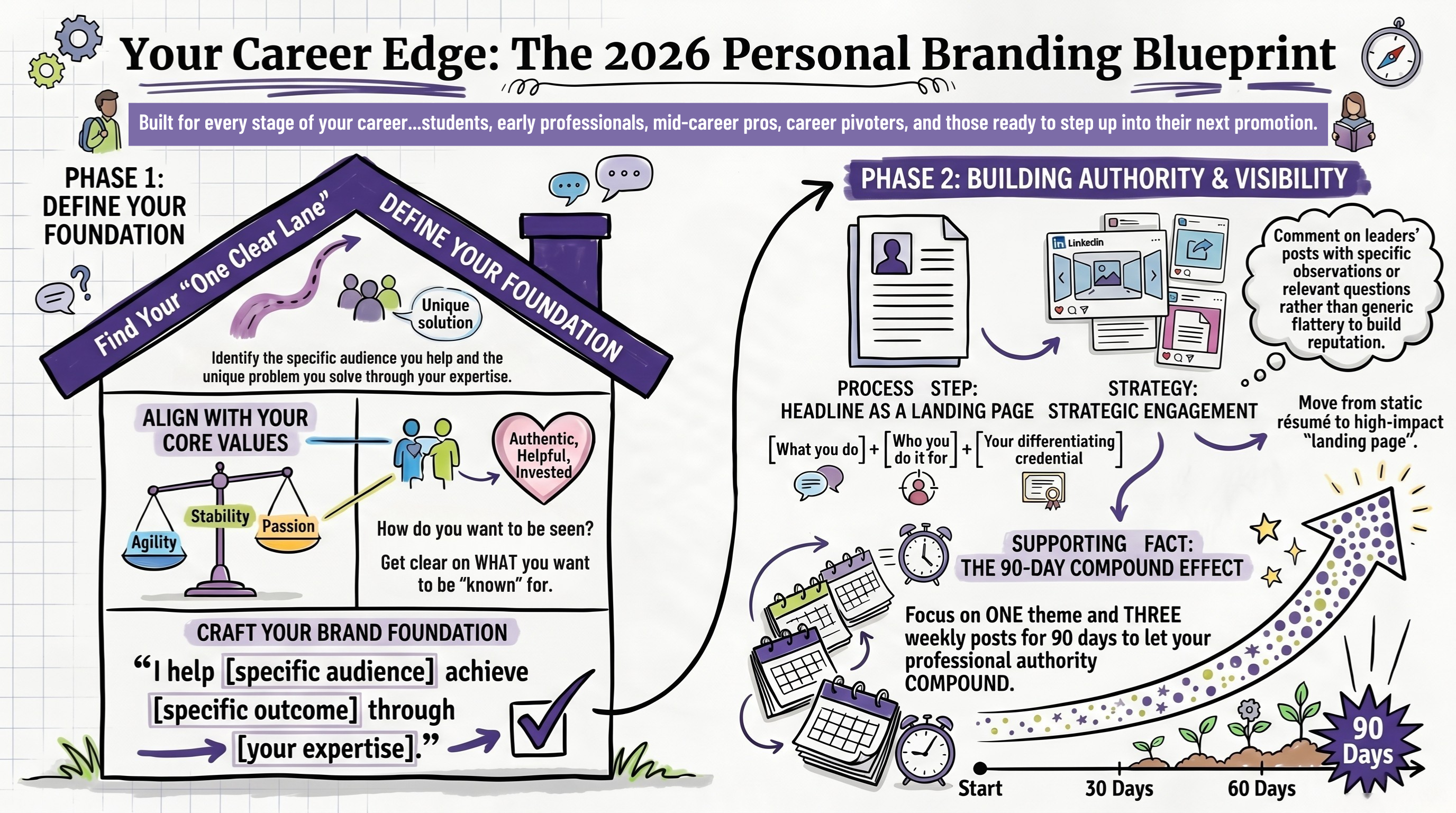
Step 1: Get Clear on What You Want to Be Known For
Personal branding starts with a decision, not a platform. Before you touch your profile or write a single post, get specific about the professional identity you want to project.
Ask yourself: What problems do I solve? Who do I solve them for? What makes my perspective or approach different from others in my field?
You don't need a grand vision. You need one clear lane. A career coach who helps first-generation professionals navigate corporate environments has a brand. A data analyst who specializes in making complex insights accessible to non-technical teams has a brand. Generalist positioning sounds safer but lands weaker.
Action Plan:
- Write one sentence that completes this prompt: "I help [specific audience] achieve [specific outcome] through [your approach or expertise]." That sentence is the foundation of your brand.
- Look at the profiles of three people in your field whose careers you admire. Notice how they describe themselves. What language do they use? Where are you different?
- List the top three topics you could talk about with genuine confidence and depth. Those are your content pillars, the themes you'll return to again and again to build recognition.
Step 2: Build a Profile That Does the Talking for You
Once you know what you stand for, your profile needs to communicate it instantly. Think of your LinkedIn profile as a landing page, not a résumé. A résumé is reactive. A landing page is working around the clock to make a case for you.
Every section of your profile should answer one question from a visitor's perspective: why does this person matter to me?
Your headline is your highest-leverage real estate. Most people default to their job title and company name. That's a missed opportunity. The strongest headlines tell visitors who you help and what you help them do.
Action Plan: Rewrite your headline using this structure: [What you do] + [who you do it for] + [your differentiating angle or credential]. For example: "Helping healthcare organizations turn data into decisions | Health informatics, analytics, and strategy."
Your About section is where your brand comes to life. Lead with clarity, not biography. Visitors want to know what you stand for, what problems you solve, and what they should do next.
Action Plan: Structure your About section in four parts. Open with what you do and who you serve. Follow with proof: the types of problems you've solved, the outcomes you've contributed to, or the industries you've worked in. Then share what topics you post about so visitors know what to expect if they follow you. Close with a clear next step, whether that's connecting, visiting your portfolio, or reaching out directly.
Your Featured section is where brand becomes proof. Use all three slots. Pin your best teaching piece, your strongest proof of work, and your clearest call to action.
Action Plan: If you don't have existing work to feature, create something this week. A short post sharing one insight from your field, a simple slide deck explaining a concept you know well, or a link to a project or publication you contributed to. Something specific and useful beats an empty section every time.
Step 3: Create Content That Builds Authority Over Time
Posting on LinkedIn isn't about going viral. It's about being consistently visible to the right people with content that demonstrates your expertise and judgment. That consistency is what turns a profile into a brand.
The good news is that you don't need to post every day. Research consistently shows that personal profiles outperform company pages on engagement, and quality drives more results than volume. Three thoughtful posts per week, combined with daily commenting on relevant content, is enough to build real presence.
The most effective content types for personal brand building are:
Expertise posts that share a lesson learned, a framework you use, an industry trend you've noticed, or a mistake you see people making in your field. These establish you as someone worth following.
Story-to-lesson posts that connect a real professional experience to a transferable insight. The story earns attention. The lesson earns trust.
Document carousels that teach something in a structured, visual format. Research consistently identifies document and carousel posts as among the highest-engagement formats on LinkedIn. If you have knowledge worth sharing, a well-designed carousel is one of the most powerful ways to share it.
Action Plan:
- Start your content with one sharp, specific sentence that gives people a reason to keep reading. Avoid generic openers. Lead with the tension, the counterintuitive observation, or the concrete promise.
- Write about what you actually know, not what you think sounds impressive. Specificity builds credibility. Vague expertise claims do not.
- Engage with every meaningful comment on your posts within 24 hours. Conversation is part of the brand. Responsiveness signals that you're a real person, not a broadcasting machine.
Step 4: Use Comments as a Discovery Tool
Here's the personal branding move most professionals overlook: commenting strategically is one of the fastest ways to increase your visibility on LinkedIn in 2026.
LinkedIn now tracks comment impressions as a distinct metric, which means your comments appear to the networks of the people you engage with. When you leave a thoughtful comment on a post from a leader in your field, you're introducing yourself to their entire audience.
This isn't about flattery. A comment that says "Great post!" does nothing. A comment that makes a specific observation, respectfully challenges a point, or connects the idea to a different context will build your reputation post by post.
Action Plan:
- Identify five to ten people in your target field or at companies you admire. Make it a habit to engage with their content regularly. Consistency matters more than frequency here.
- Before commenting, ask: Does this add something? A new angle, a concrete example, a relevant question, or a brief personal experience all qualify. If your comment could be left on any post about any topic, rewrite it.
- Track whether your comments lead to profile views. LinkedIn analytics lets you see who visited your profile and when. Comments that drive profile visits are working.
Step 5: Stay Consistent and Let It Compound
Personal branding doesn't happen in a single afternoon. It's the result of showing up with clarity and consistency over time. Each post, each comment, each updated profile section adds a layer to the impression you're building.
The professionals with the strongest LinkedIn brands aren't necessarily the most talented in their field. They're the ones who made their expertise visible, stayed consistent, and let the platform do what it does best: connect people who should know each other.
That's what a personal brand actually is. Not a performance, not a personal marketing campaign, but a clear, consistent signal that says: here's what I know, here's who I help, and here's why it matters.
Action Plan:
- Set a 90-day goal, not a lifetime commitment. Focus on one content theme, three posts per week, and daily commenting for 90 days. Review your Search Appearances and profile views at the end. The data will tell you what's working.
- Build from a simple system: one source idea per week becomes one post, one carousel slide deck, and a handful of comments. You don't need to generate new ideas every day. You need to develop the ideas you already have.
- Revisit your headline and About section every quarter. As your career evolves and your positioning sharpens, your profile should reflect that. A brand that doesn't grow eventually stops working.
The Bottom Line
LinkedIn in 2026 rewards the professionals who show up with purpose. A strong personal brand doesn't require a massive following, daily posting, or a marketing budget. It requires clarity about what you stand for, consistency in how you show up, and content that demonstrates real expertise.
Start with one section of your profile today.
Rewrite one post this week.
Leave one thoughtful comment tomorrow.
The career you're building is shaped by the small, deliberate moves you make right now.
Your edge is already there. LinkedIn is just how you make it visible.
Share your LinkedIn profile below and let's start connecting!
Source: https://www.edelman.com/expertise/Business-Marketing/2024-b2b-thought-leadership-report