Is Your LinkedIn Profile Actually Helping You Get Hired in 2026?

Superstar
🤩
Here are the 2026 best practices and the exact actions you can take today to stand out!
Most job seekers treat LinkedIn like an online résumé. You upload your work history, add a professional photo, and wait. Maybe you apply to a few jobs through the platform. Maybe you connect with a few people you already know.
Then nothing much happens.
Here's the thing: that approach made some sense a few years ago. It doesn't anymore. LinkedIn in 2026 functions less like a résumé database and more like a search-and-discovery engine, one that rewards people who show up with clarity, consistency, and real expertise. If your profile isn't optimized for how the platform actually works today, you're not just missing opportunities. You're invisible to the people who could change your career.
The good news? The gap between a forgettable LinkedIn presence and a compelling one is smaller than you think. You don't need to be an influencer. You don't need to post every day. You just need to understand what the platform rewards now and take a few targeted actions to work with it rather than against it.
This article breaks it all down, with specific action plans you can take right after reading.
Key Takeaways
- Your LinkedIn headline is the highest-leverage piece of real estate on your profile, and most people waste it on a job title.
- LinkedIn now functions as a professional search engine. Your discoverability depends on using the right language in the right places.
- Comments and engagement are measurable growth tools, not optional social gestures.
- Document and carousel formats consistently drive high engagement, even for job seekers building a professional presence.
- Human specificity is your biggest advantage in a world full of AI-generated content.
The Problem With "Set It and Forget It" LinkedIn Profiles
Let's be honest about something. Most professionals, including smart, qualified job seekers, have LinkedIn profiles that describe what they've done rather than what they can do for someone else. The Experience section reads like a list of job duties. The headline says "Marketing Manager at XYZ Company." The About section is either blank or a paragraph that restates the résumé in the first person.
That approach doesn't just fail to impress. It actively works against you.
LinkedIn's search and discovery systems have shifted significantly. The platform now evaluates profiles based on relevance and meaning, not just keywords. Recruiters using LinkedIn's AI-powered search tools get results based on what they're actually looking for, which means your profile needs to speak the language of the opportunities you want, not just the jobs you've had.
Recent benchmark data reinforces why this matters. LinkedIn's Search Appearances tool now shows you exactly which job titles searchers used to find your profile, which companies they're from, and how often your profile appeared in results. If you're being found for the wrong roles, or not found at all, that's data you can act on.
The path forward isn't complicated. It starts with understanding what LinkedIn actually rewards in 2026, then making a handful of deliberate changes that position you for the opportunities you're actually after.
Your Profile Is a Landing Page, Not a Résumé
This is the single most useful reframe for job seekers using LinkedIn today.
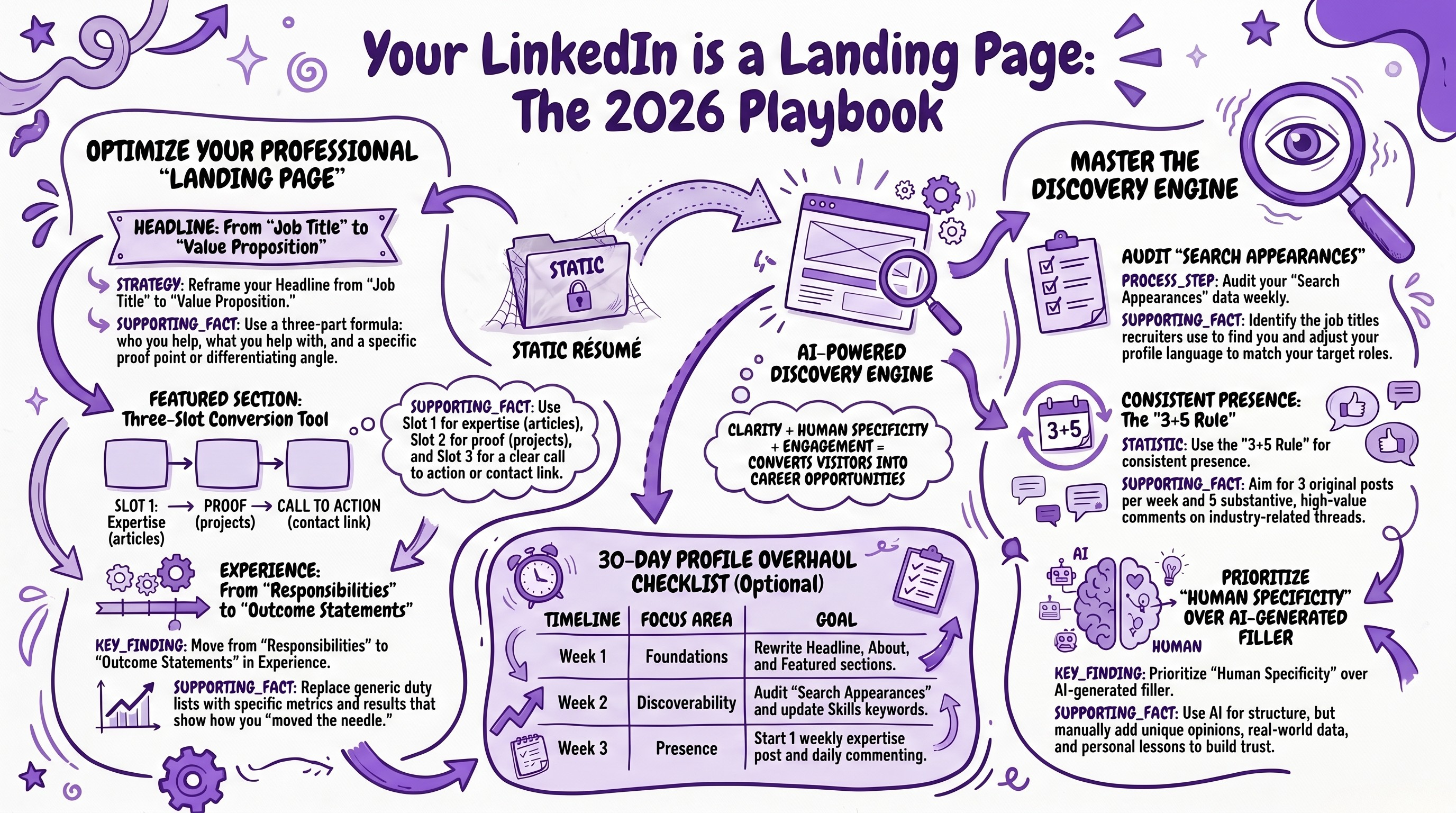
A résumé is a document you send when asked. A landing page is what people encounter when searching, and it has one job: to turn visitors into believers. Your LinkedIn profile, when done well, does exactly that. It takes someone who stumbled across your name and convinces them you're worth a conversation.
That means every element of your profile needs to work together to answer three questions fast: Who is this person? What can they do for me? What should I do next?
Your Headline: Stop Wasting Your Best Real Estate
The headline is the first thing people see after your name, and it appears in search results, comment threads, recruiter searches, and everywhere else on the platform. The default LinkedIn behavior is to populate it with your current job title and employer. That's not enough.
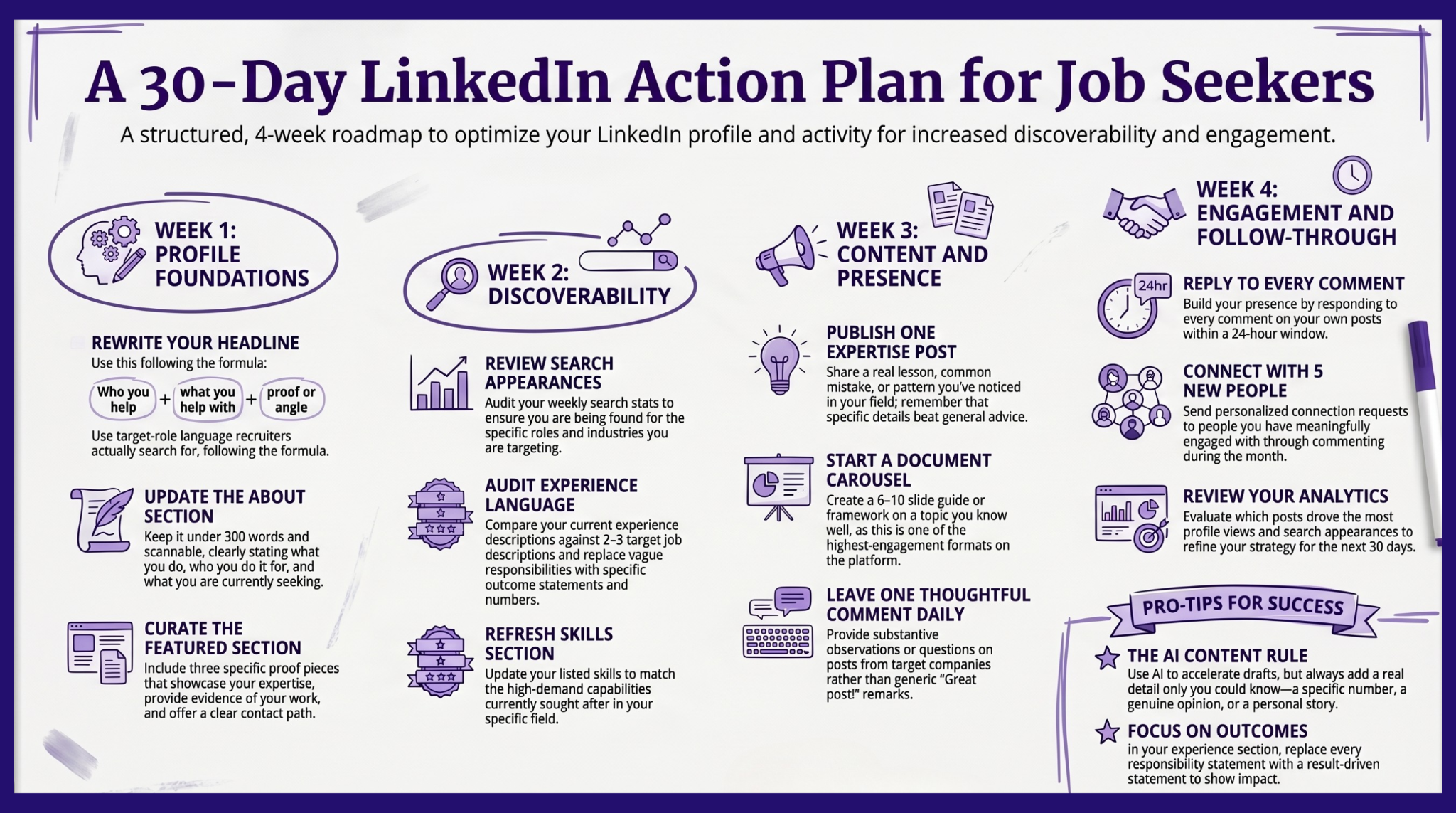
The strongest headlines follow a simple structure: who you help, what you help with, and a proof point or differentiating angle.
Instead of: Marketing Manager | XYZ Company
Try: Helping B2B brands turn content into pipeline | Brand strategy, campaigns, and audience growth
Instead of: Recent Graduate | Finance Major
Try: Finance graduate helping companies analyze data and tell clearer stories | CFA Level I candidate
You don't need to be clever. You need to be clear. Use language your target audience would actually search for, not the internal language of your current employer.
Action Plan: Open your LinkedIn Search Appearances tab.
From your profile (fastest way)
- Go to your profile
- Scroll down to the Analytics section (right under your headline/about area)
- Look for “Search appearances”
- Click it → this opens your full breakdown
Look at the job titles you're currently being found for. If they don't match what you're actually targeting, rewrite your headline using the exact language recruiters in your target field use.
Your About Section: Make It Do More Work
LinkedIn moved the About section higher on profiles after removing the old creator mode structure. It now does more strategic work earlier in the visitor journey, which means more people are reading it, and faster.
The strongest About sections for job seekers follow this structure:
- What you do and who you do it for: one to two clear sentences
- What kind of problems you solve or what you bring to the table: specific, not generic
- Proof: a short list of outcomes, accomplishments, or areas of focus
- What you're looking for or open to: give people a reason to reach out
You're not writing a cover letter. You're writing for someone with 30 seconds who is trying to decide whether to look further. Make their decision easy.
Action Plan: Write your About section as if you're answering the question: "Tell me about yourself in 90 seconds, and make it interesting." If your current About section couldn't hold someone's attention for that long, rewrite it this week. Keep it under 300 words. Make it scannable.
Your Experience Section: Show Proof, Not Just History
Here's where most people leave the most value on the table. The Experience section defaults to listing responsibilities. What it should do is demonstrate outcomes.
Recruiters and hiring managers are not looking for someone who "managed a team" or "supported cross-functional initiatives." They're looking for someone who moved the needle on something real.
Instead of: Managed social media accounts and created content for multiple platforms.
Try: Grew LinkedIn following from 800 to 12,000 in 18 months through a weekly thought leadership series and daily engagement strategy. Increased average post reach by 340%.
Not every role will have clean metrics. That's okay. You can still be specific about the type of problems you worked on, the size of teams or budgets you touched, and the categories of results you contributed to.
Action Plan: Pick one role in your Experience section and rewrite just the first bullet. Replace a responsibility statement with an outcome statement. Numbers, even approximate ones, matter. Specifics beat generics every time.
Your Featured Section: The Most Underused Conversion Tool on LinkedIn
The Featured section sits near the top of your profile and lets you pin up to three pieces of content: documents, links, articles, posts, or media. Most job seekers either leave it empty or add something they posted once and forgot about.
Think of it differently. Your Featured section is a three-slot showcase. Use it to answer the three questions a visitor is silently asking:
- Slot 1: "What do you know?" A document, article, or post that demonstrates your expertise
- Slot 2: "Have you done this before?" Proof: a project, case study, portfolio piece, or talk
- Slot 3: "How do I connect with you?" A way to start a conversation or learn more
If you don't have a document or article yet, start simple. A well-crafted post that summarizes your professional POV, or even a link to a project or publication you contributed to, is a strong start.
Action Plan: Check your Featured section right now. Is it empty? Outdated? Are all three slots being used? Update it with the three best pieces of proof you have. If you're building from scratch, create a short post this week sharing one hard-won career lesson and pin it.
LinkedIn Is a Search Engine. Use It Like One.
This is the part most job seekers underestimate.
LinkedIn's search experience has shifted toward semantic, conversational results. When a recruiter types "supply chain analyst with manufacturing experience," the platform is not just matching exact keywords. It's evaluating meaning and relevance. Your profile needs to speak that language clearly enough to show up.
A few places where your language choices matter most:
Headline: Use the exact job title or role descriptor that people in your target field would search for. Not a creative spin on it. The actual words.
About section: Naturally include the industries you've worked in, the types of problems you solve, and the categories of skills you bring, written the way a recruiter in your space would phrase them.
Experience section: Name the tools, methodologies, and deliverables that are common in your target field. "Managed stakeholder communications" is vague. "Managed executive-level stakeholder communications for a $40M product launch" is searchable.
Skills section: Keep it up to date and relevant. Recruiters filter by skills. If a skill is central to your target role and isn't on your profile, you may be filtered out before a human ever sees your name.
Action Plan: Check your search results. Go back to your Search Appearances (described above). Identify the top three job titles people used to find you. If those titles don't align with your goals, audit your profile language against a few job descriptions for roles you actually want and update accordingly.
Building Presence Through Content (Without Posting Every Day)
Here's a question worth sitting with: When a recruiter or hiring manager visits your profile after seeing your application or finding you in search, what do they see? Just a profile, or a person with a clear professional point of view?
Content on LinkedIn isn't about becoming an influencer. For job seekers, it's about demonstrating expertise and judgment before you're even in the room.
The good news: you don't need to post daily. Research consistently shows that personal profiles outperform company pages on engagement, and quality matters more than volume. A baseline of three thoughtful posts per week, combined with daily high-value commenting, is enough to build real presence and visibility.
What to Post
The most effective content for job seekers building credibility tends to fall into a few categories:
Expertise posts: Share a lesson learned, a framework you use, an industry observation, or a common mistake you see in your field. These posts build professional credibility without requiring you to be an expert. Just be specific and honest.
Story-to-lesson posts: Something happened. You figured something out. You share the lesson. Personal professional stories that connect to a useful takeaway consistently drive meaningful engagement.
Document carousels: The data is clear here. Document and carousel formats consistently rank among the highest-engagement content types on LinkedIn, particularly for teaching complex ideas. If you have a framework, a process, or a guide to share, a 6-10-slide document carousel is one of the most powerful ways to do so.
The Most Overlooked Growth Strategy: Commenting
LinkedIn now measures comment impressions separately from post impressions. That means comments are not just gestures of engagement. They're a measurable distribution mechanism.
When you leave a thoughtful, specific comment on a post from someone in your target field, it appears to that person's network. If that person is a recruiter, a hiring manager, or a leader at a company you want to work for, you've just introduced yourself to an audience you'd never otherwise reach.
This isn't about flattery. Generic comments ("Great post!") don't move the needle. Comments that add a specific observation, a data point, a different angle, or a useful question will build your reputation.
Action Plan: For the next five business days, leave one substantive comment per day on a post from someone in your target field or at a company you're interested in. Track whether anyone from those posts views your profile. You may be surprised.
The AI Question: How to Use It Without Getting Lost in the Crowd
AI writing tools are now nearly universal in professional content workflows. LinkedIn itself offers AI-assisted writing for headlines, About sections, and posts for some Premium users.
That widespread availability creates both an opportunity and a trap.
The opportunity: AI can help you get past the blank page, accelerate a first draft, and improve the structure of your writing.
The trap: When everyone uses AI to generate content, content starts to sound the same. Profiles blend together. Posts feel hollow. The features that actually build trust, like real opinions, specific examples, and lived experience, get smoothed out.
The 2024 Edelman-LinkedIn B2B Thought Leadership research found that decision-makers often trust thought leadership more than standard marketing materials, but only a small percentage rated what they read as excellent. The gap between mediocre and excellent is largely a question of specificity and human judgment.
Here's the practical rule for job seekers: use AI to accelerate the content structure and drafting process. But before anything goes live, add the details only you could know: the specific project, the actual number, the real lesson, the opinion you actually hold. That's what makes content worth reading and profiles worth remembering.
Action Plan: If you've been using AI to draft LinkedIn content, pick your last three posts and identify one place in each where you could have added a specific personal detail, data point, or genuine opinion. Then make that addition. Compare how they feel.
Timing, Consistency, and the Long Game
A few practical notes on how to build and maintain presence without burning out.
When to post: Research consistently points to Tuesday through Thursday during business hours as the broadest high-engagement window. But timing is less important than consistency. A post on Friday that shows up is better than a post on Tuesday that you never got around to writing.
How often: Three original posts per week, plus daily commenting, is the evidence-backed baseline for most professionals building presence on LinkedIn. If that feels like too much, start with one post per week and five thoughtful comments. Build from there.
What to measure: LinkedIn gives you real analytics on what's working. Track profile views, search appearances, and, most usefully, followers gained from specific posts and profile viewers from posts. If a certain type of content consistently drives profile views, you've found something worth repeating.
Frequently Asked Questions
Does LinkedIn still use hashtags? LinkedIn removed profile hashtags as part of its recent platform updates. While hashtags can still appear in posts, the current guidance is to use one to three relevant topical hashtags if they add context, not to drive reach. Focus on content quality and engagement over hashtag strategy.
Should I set my primary action to "Follow" or "Connect"? For job seekers focused on building visibility and attracting inbound interest, "Follow" is often the stronger choice. It makes it easier for people to see your content without requiring a mutual connection. If your strategy depends on building a smaller, higher-trust network, "Connect" may be a better fit. Most job seekers benefit from "Follow" as the primary action.
How long should my posts be? LinkedIn doesn't publish universal optimal character counts. The most useful guidance is editorial: open with one sharp, specific sentence that earns the next click, then develop one idea well. Avoid multi-topic posts. The best LinkedIn posts are long enough to deliver real value and short enough to finish.
What's the difference between a LinkedIn article and a newsletter? Articles are standalone, evergreen pieces, good for reference content you want to rank and be shared. Newsletters have recurring subscriber mechanics: when you publish a new edition, subscribers get notified, and LinkedIn invites your connections to subscribe after your first issue. If your content has a recurring theme, a newsletter is typically the better long-term format.
Does my LinkedIn profile actually show up in Google searches? Yes, if your public profile settings allow it. LinkedIn profiles with complete, keyword-relevant language can appear in external search results, though changes take time to propagate. Treat your LinkedIn profile as both an on-platform and off-platform asset. Public visibility is on by default for most accounts, but worth confirming in your settings.
The Bottom Line
LinkedIn in 2026 rewards clarity, consistency, and genuine expertise over generic content and passive presence. That's actually good news for job seekers who are willing to be specific about what they know, who they can help, and what they're looking for.
You don't need a massive following. You don't need to post every day. You need a profile that does its job when someone lands on it, content that demonstrates real judgment, and enough consistent engagement to stay visible to the people who matter.
The professionals who stand out aren't necessarily the most experienced. They're the ones who show up with purpose and make it easy for the right people to say yes.
Start with one action from this article. Build from there. The career you're working toward is built one smart move at a time.
Source: https://www.edelman.com/expertise/Business-Marketing/2024-b2b-thought-leadership-report