FRM Resume: From Report Generator to Risk Influencer


Your FRM (Financial Risk Manager) resume must transform from a list of passive back-office reporting tasks into a projection of authority and influence to secure a C-suite seat.
Risk Management is a leadership role, and your resume must prove you have the "quant" backbone and the "cool head" to actively defend the firm's capital.
Strategy: Adopt the Preventive Value Model
Restructure your experience to show that your technical skills are active defense mechanisms and strategic safeguards. Focus on these three essential pillars:
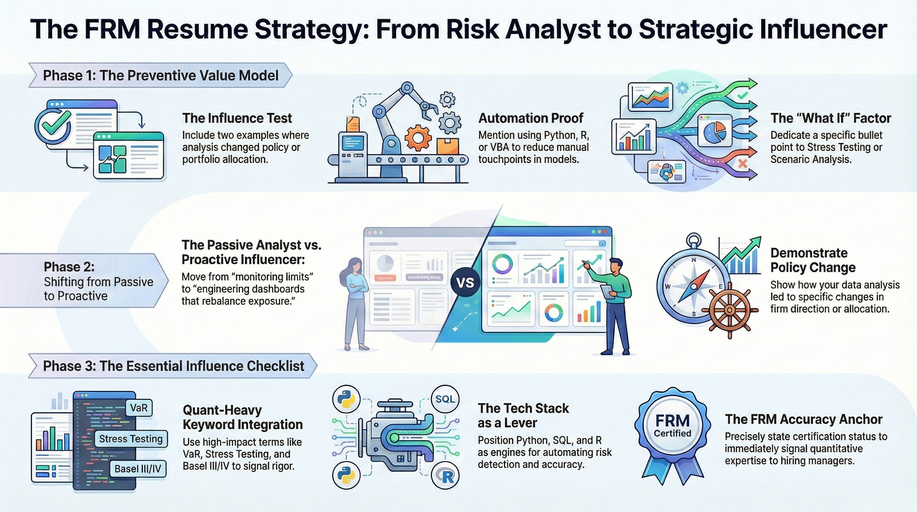
- Quant-Heavy Keyword Integration: Move beyond "measured risk" and use high-impact terms hiring managers search for: VaR (Value at Risk), Stress Testing, Monte Carlo Simulations, Expected Shortfall (ES), and Basel III/IV compliance.
- The FRM Accuracy Anchor: Immediately signal your quantitative rigor by precisely stating your certification status (e.g., "FRM Candidate (Passed Parts I & II)" or placing the designation next to your name if certified).
- The Tech Stack as a Lever: Showcase tools like Python (Pandas, NumPy), SQL, R, SAS, or MATLAB as the engines that automate risk detection and dramatically improve model accuracy.
Shift from Passive Analyst to Proactive Influencer
Demonstrate the ability to change the firm's direction with your data:
- Passive Analyst: Monitored daily market risk limits and sent out compliance reports using Excel and SQL.
- Proactive Influencer: Engineered a real-time risk dashboard using Python and SQL that flagged a 15% breach in limits, allowing the desk to rebalance $40M in exposure before a period of high volatility.
Essential FRM Resume Checklist
Ensure your resume is built for influence by including:
- The Influence Test: At least two examples where your analysis led to a specific change in policy or portfolio allocation.
- Technical Precision: Integration of terms like "Monte Carlo," "Backtesting," and "Greeks" within your bullet points.
- Automation Proof: A mention of using Python, R, or VBA to reduce "manual touchpoints" in a risk model.
- The "What If" Factor: A specific bullet point dedicated to Stress Testing or Scenario Analysis during a specific market event.
Join the conversation:
Which technical skill (Python, R, SQL, etc.) do you consider the most critical for risk automation and career advancement right now? Let us know in the comments!