Five ways to build your interview presence📝

The "interview season" shouldn't be the first time you practice your interpersonal skills. Like any clinical procedure, interviewing is a muscle that requires reps.
Here are five ways to build your interview presence while you’re still in the trenches of your pre-med years.
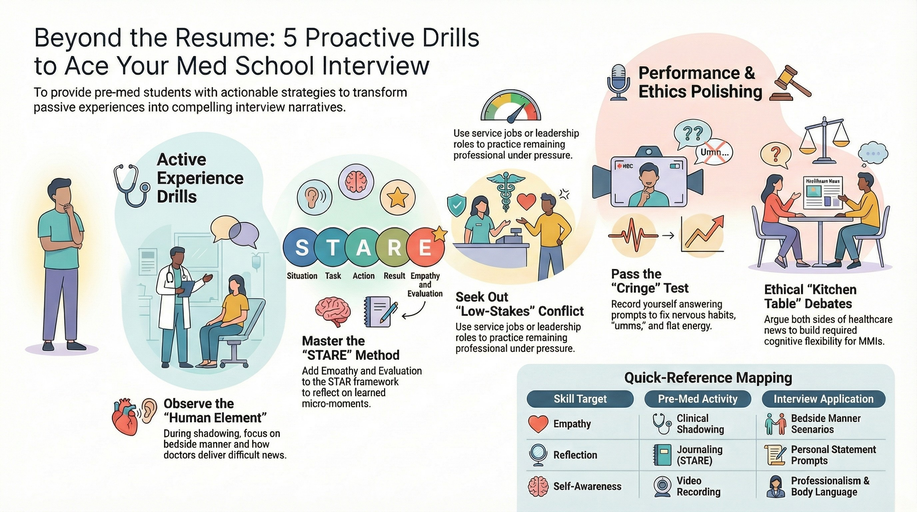
1. The "Patient-First" Narrative: Reframe Your Shadowing
Most pre-meds treat shadowing like a spectator sport. To build interview skills, treat it like a case study in communication.
- The Drill: Instead of just watching the procedure, watch the doctor’s bedside manner. How do they deliver bad news? How do they handle a non-compliant patient?
- The Value: When an interviewer asks, "Tell me about a time you saw a challenge in healthcare," you won’t give a generic answer. You’ll have a specific, nuanced observation about the human element of medicine.
2. Master the "STARE" Method (with a Twist)
You’ve likely heard of the STAR method (Situation, Task, Action, Result). For med school, we add an E for Evaluation/Empathy.
- The Drill: For every volunteering shift or club meeting, write down one "micro-moment" using this framework.
- Why it works: Med school interviews, especially MMIs (Multiple Mini Interviews), test your ability to reflect. If you can explain not just what you did, but what you learned about human nature from the experience, you’re already ahead of 90% of applicants.
3. Seek Out "Low-Stakes" Conflict
Conflict resolution is a favorite topic for admissions committees. If your life is perfectly smooth, you’ll have nothing to talk about.
- The Drill: Take on a leadership role or a customer service job (yes, waitressing counts as pre-med prep!). When a teammate isn't pulling their weight or a customer is irate, don't shy away.
- The Value: These moments are gold mines for the "Tell me about a time you handled a difficult person" prompt. It proves you can remain professional under pressure.
4. Record and Review (The "Cringe" Test)
We all have "umms," "likes," and weird nervous habits. You don’t want to discover yours during a Harvard interview.
- The Drill: Use your phone to record yourself answering a basic prompt: "Why do you want to be a doctor?" * The Value: Watch it back. Are you making eye contact with the lens? Is your energy level flat? It’s painful to watch at first, but it’s the fastest way to polish your delivery and ensure you sound like a confident future physician, not a rehearsed robot.
5. Practice Ethical "Kitchen Table" Debates
MMIs often throw ethical curveballs at you (e.g., organ donation priority or patient autonomy).
- The Drill: Follow a healthcare news outlet. Pick one controversial topic a week and try to argue both sides of the issue with a friend or family member.
- The Value: The goal isn't to be "right"; it's to show you can see multiple perspectives. This builds the cognitive flexibility required for the high-pressure ethics stations.
Summary: Your Interview Prep Checklist
Skill | Pre-Med Activity | Interview Application |
|---|---|---|
Empathy | Clinical Shadowing | Bedside Manner Scenarios |
Reflection | Journaling (STARE) | Personal Statement/Secondary Prompts |
Conflict Resolution | Retail/Service Jobs | "Difficult Teammate" Questions |
Self-Awareness | Video Recording | Professionalism & Body Language |
Ethics | Reading Health Policy | MMI Ethical Dilemmas |
Let's Talk About It!
Service jobs like waitressing or retail are secret weapons for med school apps. What’s the most "med school-relevant" lesson you’ve learned from a non-clinical job?