Is Virtual School Better Than In-Person Learning? Pros and Cons Compared


As parents and guardians, you’re often forced to choose between two very different worlds for your teen: the traditional classroom and the virtual one. After observing how high schoolers adapt to both, it’s clear that the "best" option isn't universal—it’s about matching the environment to the student's specific learning profile.
If you’re weighing these two paths for your teen, here is a clear breakdown of the trade-offs that can help you make an informed decision.
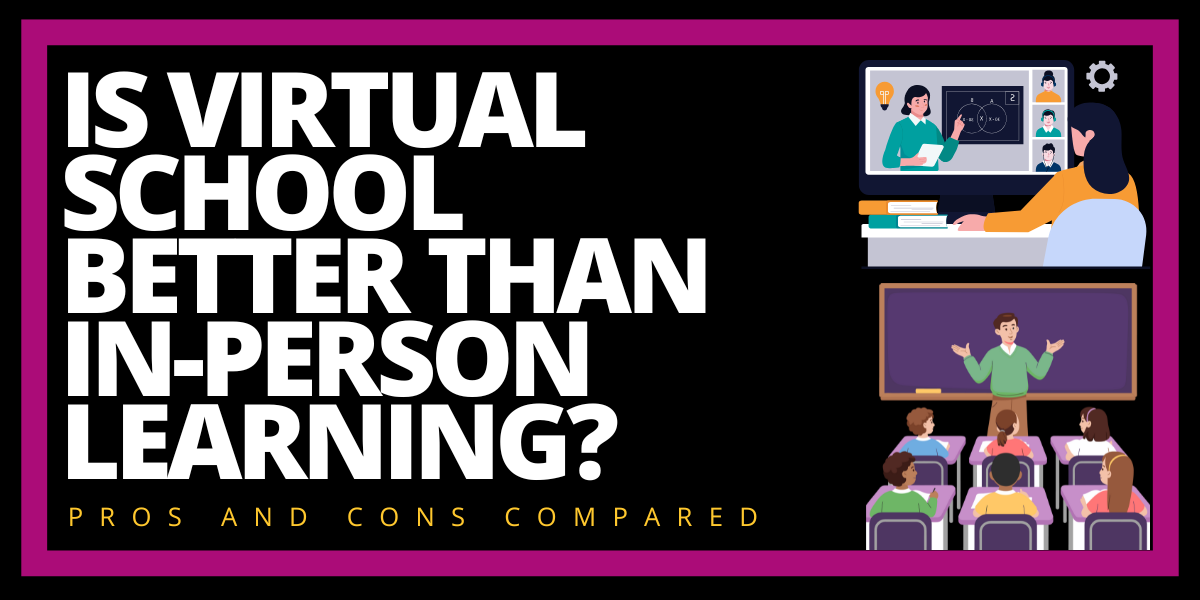
Virtual: Autonomy and Focus
Online schooling has evolved far beyond the "emergency remote learning" of the past. It is now a deliberate choice for specific types of learners.
- Pro: Executive Functioning Development. For the right student, virtual school is a masterclass in time management and digital literacy—skills that are non-negotiable in the modern workforce.
- Pro: Targeted Learning. Students can often bypass the "filler" time of a school day, allowing them to deep-dive into subjects they love or move quickly through what they’ve already mastered.
- Con: The "Soft Skill" Gap. We see a decrease in opportunities for "unstructured conflict resolution"—the small social frictions that happen in hallways which teach teens how to navigate difficult people.
In-Person: The Social Ecosystem
The traditional high school remains the gold standard for collaborative development and holistic support.
- Pro: Relational Learning. Many teens find their "why" through a specific coach, a drama teacher, or a peer group. These face-to-face micro-interactions are the primary drivers of school engagement.
- Pro: Immediate Intervention. In a physical classroom, a teacher can read a student's body language and see "the look" of confusion. That nuance is often lost in a sea of black boxes on a screen.
- Con: The Cognitive Load. Between the early start times, the sensory overload of a crowded building, and the social "performance," many students arrive at their actual lessons already mentally exhausted.
The goal isn't just to get them through the curriculum; it’s to place them in an environment where they feel capable. If your teen is struggling in one, it isn’t a failure of the student—it’s often a mismatch of the "ecosystem."
Which one is your teen currently doing? If you could switch tomorrow, would you? Let’s swap experiences in the comments!
Comments
-
My son is in-person, but when he does homework he uses YouTube lessons and other online resources. So, he is learning both in class and online. He enjoys spending time with friends at school. However, classroom disruptions make it hard to learn. So, I see the appeal of online learning provided he has a chance to interact with other teens in real life.
3 -
Same! I see the appeal of both, but for subjects I struggled with—like math—I definitely needed to be in person. For everything else, I preferred online; it let me go at my own pace without all the classroom distractions.
2 -
@KatherineGalland_KCT What was your preference? 👀
2 -
I graduated high school in 2020 so my last semester of high school was completely virtual, as well as my first year of college! For me, virtual learning is definitely more convenient but I found it much harder to absorb information and connect with my peers. Because of virtual learning I didn't really make any friends at school until my junior year of college when things went back to "normal." But that was also emergency remote learning. I think I might have different opinions about it if I had the choice, but once we went back to class I found I absorbed material much more in an in-person environment!
4


Categories
- All Categories
- 310 Career Community
- 28 Career Success Hub
- 38 Finance Careers
- 85 Healthcare Careers
- 74 Legal Careers
- 57 Real Estate Careers
- 195 Parents & Guardians
- 676 Financial Planners
- 256 Law Students
- 2 Parents
- 370 Pre-Law
- 878 Pre-Med
- 3.2K Real Estate Professionals
- 12 Business School
- 6 Business School Success
- 4 Community Information
- Engineering Community